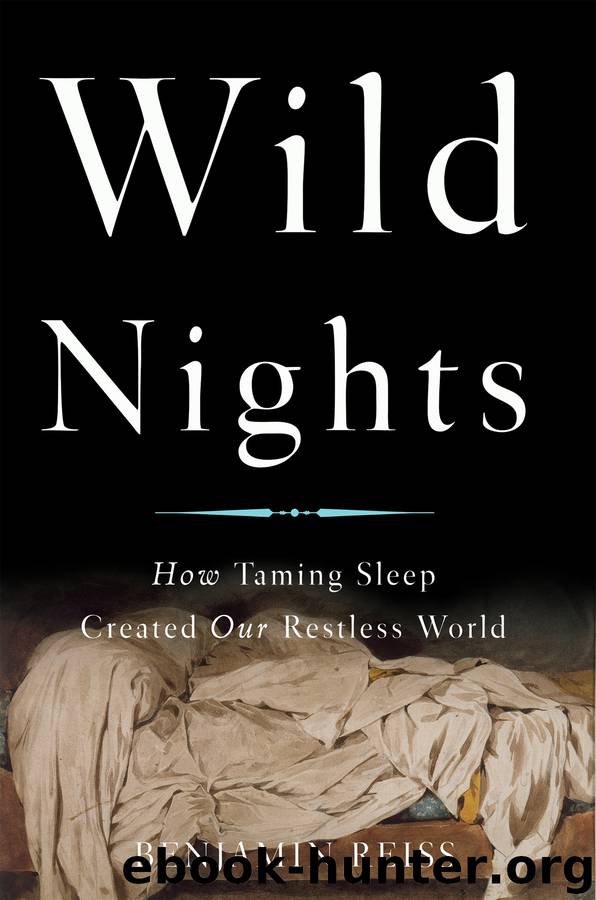
Wild Nights: How Taming Sleep Created Our Restless World by Benjamin Reiss
Author:Benjamin Reiss
Language: eng
Format: epub
Publisher: Basic Books
Published: 2017-03-07T05:00:00+00:00
There are exceptions, of course. In a class on sleep that I taught at Emory, my co-teacher David Rye and I asked students to indicate whether they had slept in their own beds by age six. All but three of them raised their hands. Of those three, two were African American and the other had grown up in India. The solitary sleepers were either white or Asian American. In many places around the world, autonomous childhood sleeping is not practiced or even contemplated. In India, China, Indonesia, and Egypt, for example, private sleeping rooms are the exception rather than the rule. All available historical and cross-cultural evidence suggests that solitary sleeping for children is an anomaly of the modern, industrialized West. No ethnographic research has found a widespread tradition of infants sleeping outside of the mother’s room anywhere else.
At least as much as changing theories of children’s psychosocial development, and changing ideas about the sexual morality of family life, new domestic arrangements explain how children’s sleep became such a problem. As with most shifts in human social behavior, there is no precise date when parents in Europe and North America began to put their children into separate beds within specially appointed rooms during the night. Historian of childhood Philippe Ariès cited an example of seventeenth-century French bishops who “prohibited—with a vehemence that gives one pause—the practice of having children sleep in the beds of their parents.” A health manual published in 1781 recommended that children be put in beds apart from parents early in infancy, which would allow the sleeping child’s body to regulate its own temperature and reduce the risk of the child being smothered by a sleeping parent rolling over in the night. Clearly, though, there were limits to how far away one could put the child. Most early modern European homes had only two or three rooms, and prior to the mid-seventeenth century the hallway was usually the chief sleeping space.
Most scholars of childhood cite the nineteenth and twentieth centuries as the crucial period for the rise of solitary childhood sleep. According to historians Peter Stearns, Perrin Rowland, and Lori Giarnella, in the mid-nineteenth-century United States, middle- and upper-middle-class children usually slept near a nurse in infancy and then shared a bed with same-sex siblings (Henry David Thoreau, for instance, in the trundle bed with his brother John). By the 1890s, as cribs began to replace cradles, even very young children were separated from their parents at night, and by the early twentieth century many middle-class homes had separate bedrooms for each child. The behavioral psychologist John Watson—who argued that too much coddling could stunt a child’s development—wrote in 1928 that “when the 25 million American homes come to realize that the child has a right to a separate room and adequate psychological care there will not be nearly so may children born”; and an article in a 1920s family magazine asked children: “Do you sleep in a bed all by yourself? It is much better to sleep by yourself.
Download
This site does not store any files on its server. We only index and link to content provided by other sites. Please contact the content providers to delete copyright contents if any and email us, we'll remove relevant links or contents immediately.
| Anthropology | Archaeology |
| Philosophy | Politics & Government |
| Social Sciences | Sociology |
| Women's Studies |
Born to Run: by Christopher McDougall(7127)
The Leavers by Lisa Ko(6948)
iGen by Jean M. Twenge(5416)
Sapiens by Yuval Noah Harari(5372)
Spare by Prince Harry The Duke of Sussex(5197)
The Kite Runner by Khaled Hosseini(5180)
Machine Learning at Scale with H2O by Gregory Keys | David Whiting(4313)
Bullshit Jobs by David Graeber(4192)
Never by Ken Follett(3957)
Goodbye Paradise(3810)
Livewired by David Eagleman(3775)
Fairy Tale by Stephen King(3399)
A Dictionary of Sociology by Unknown(3085)
Harry Potter 4 - Harry Potter and The Goblet of Fire by J.K.Rowling(3074)
The Social Psychology of Inequality by Unknown(3031)
The Club by A.L. Brooks(2926)
Will by Will Smith(2920)
0041152001443424520 .pdf by Unknown(2846)
People of the Earth: An Introduction to World Prehistory by Dr. Brian Fagan & Nadia Durrani(2739)
